I think Sam and Anna's communication has always been advanced for their age, and I can't tell you how relieved I have been that that has been the case. Typically, twins are at a higher risk for language delays because the attention gets shared from the very beginning, and because there's someone to babble along with that might decrease the desire to learn harder how to communicate using words. Even though speech concerns haven't been the case for us, I continued signing with Sam and Anna and I still teach them new signs as they come up. Signs aren't replacements for words for them; they accompany the words for us. Sam and Anna rarely make signs without saying or attempting to say the words while doing them, even from the very first signs they learned.
As their vocabulary grows daily, some signs they've learned along the way have been dropped. I never see the "milk," "all done," or "bath" sign anymore... but it's probably more because of me than them, because somewhere along the way I stopped using the sign when saying those words. However, some signs like "Thank you" have stuck around. Anna and Sam never say the words without signing it as well... as far as I know, they might think they both have to be done for it to make sense!
Even though Sam and Anna are now over 2 years old and saying sentences with 5+ words regularly, I don't have any plans on dropping signing from our daily life. Right now, Anna is very interested in signing color words along with saying them. If that helps her make the connections to retain identifying all 11 basic colors, I'm all for it. We've also been practicing letter signs lately. While Sam definitely seems less interested in learning signs these days, Anna is as into it as ever. She'll hold out her hands after I model a sign with my hands, requesting that "Mama do it"- meaning, "please show me how with my fingers too."
Here's my reasoning for carrying on with signing, even though my children are proficient speakers for 2 year olds:
1.) If we are out and about and one is misbehaving, I can communicate a stern "no" without yelling, even if they are across the playground.. or if I am on the phone or talking to another person. In a loud place, I'll be able to communicate with my children, even if they can't hear what I am saying. I can communicate in places we need to be quiet... like church or the library.
2.) I look at sign language as learning another language, like Spanish or German. Two languages reinforce each other. I vaguely remember hearing studies show that bilingual children have higher academic abilities, or something like that. Since kids can talk AND sign at the same time, they both work together to help children that sign get better at both.
3.) There are words that Sam and Anna don't say perfectly yet. Orange being one of them. Some sounds are later developing, and some aren't even typically expected to be mastered until age 7 or 8! If my children can sign words that are more difficult to pronounce, I have a greater chance of accurately interpreting what they are tying to say.
4.) I think sign language will help them learn to read. Many signs are finger-spelled (like park), and many signs use the beginning letter to make the sign (like yellow). Plus, I think signing the alphabet decreases the chance that Sam and Anna will think LMNOP is one letter!
5.) Signing will continue to help Sam and Anna increase their vocabulary. Often signs look like what they represent. This helps them grasp the meanings and remember new words based upon that. For example, the sign for hippo looks like the hippo's big mouth is opening while the sign for rhinoceros mimics the rhino's horn on his nose. I am confident that Sam and Anna make this connection when they seen pictures of those animals- that a hippo has a large mouth and and rhino has a horn on the end of its nose. Without learning those signs, I am not sure they would be making that connection.
6.) Toddlers like to move! Signing can definitely get a child moving... and it also can help a child focus if they have to play attention to what they are seeing, not just hearing.
7.) This is a stretch, but, I also think there is a chance that knowing how to sign as an older child will help Sam and Anna accept differences in others. They won't be uncomfortable if a deaf child is playing on the playground and stare... and who knows? Maybe they will even communicate and play with them.
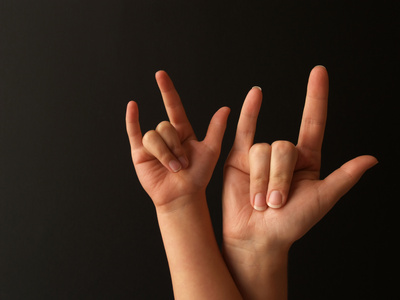
My mom signed "I love you" to me even in the teen years to give me courage when I was doing something that shook my nerves, when the space between us was too far to say it out loud. I can bet she signed it to me when the bus I was riding on to camp for the first time pulled out of the parking lot in elementary school. I hope I can do the same when Sam and Anna are on a sports field, standing on a stage, or wearing a graduation cap and gown.
(My thanks to Kerri, who inspired this post and got my brain thinking about why I still sign with Sam and Anna!)
* edited to add: that we still watch Signing Time DVDs at least once a week. I've found that typically they are the least expensive on Amazon.

3 comments:
Don't get me wrong-- I think signing is fantastic. It was an absolute lifesaver for us when we realized Camden's language was delayed. It saved us many tantrums out of frustration, I have no doubts about that.
When people debate whether signing actually contributes to speech delay (my feeling is that it absolutely does NOT), advocates for signing (including camden's pedi and SLP) both sighted the fact that, as toddlers learn to speak, the signs are naturally dropped. That's why I thought it was interesting (and neat) that Sam and Anna have managed to keep up both. I like your reasoning for continuing to sign with them too. Makes good sense to me. And this post is another great example of how signing does not delay language (I hate that argument) .
Katie, I have been signing with Carder since early on. He has yet to sign back, but I can imagine that takes some time as well. I plan on keeping it up and I hope he signs back soon.
I would love to pick up some of the Baby Signing Time videos you have mentioned. Can you pass along where you find those? All online or in some stores?
Thanks!
It's really great that it has worked so well for you.
I have mixed feelings about signing. We didn't start signing with them until about 13 months, and then the new babysitter came along and does a LOT of signing with them. I feel like for a while it helped a lot with communicating, but now I think that there are times when they will sign instead of saying words they know. So, I have to prompt them to use the word! Like, they will leave the "more" out and just say "please".
I spoke with our speech pathologist and she said that it happens a lot, that kids will sign and not speak... that it can cause delays if relied upon too much.
I think that my girls have an awesome vocabulary for their age, but I am definitely going to reinforce that they say whatever they sign.
Of course... apparently I say, "oh god" too often, because Addison has started saying it and with the same emphasis as I do! Hilarious! And a tad embarassing!
Post a Comment